In our “Fear or feast” paper, recently published in the academic journal Wildlife Biology, we reported that insectivorous small mammals are attracted to large mammalian carcasses in an African grassland ecosystem despite black-backed jackals, a meso-carnivore often depredating small mammals, also being attracted to this ephemeral food source.
The results we report form part of a much larger “Death in the Long grass” project, designed to
investigate the ecological impacts of large mammalian carcasses on a grassland
system. Using a combination of sites with an adult male blue wildebeest (Connochaetes taurinus) carcass and without a carcass (control sites), we designed a Before, After, Control,
Impact (BACI) experiment and measured beetle activity using pitfall traps,
small mammal activity using small mammal traps, and meso-carnivore activity through
camera traps, before carcass deployment and then through the active decomposition phase following carcass deplpoyment.
While small mammal activity changed seasonally, we found that the presence of a carcass resulted in an increase in small mammal activity. The increase in small mammal activity likely was due to the increase in beetles (coleopterans) – invertebrate scavengers that play a vital role in carcass breakdown – that the small mammals feed on. The increase in jackal activity was primarily due to the large amount of carrion available.
In this landscape, the carcass therefore attracted invertebrate and vertebrate scavengers, temporarily increasing both food availability and predation risk for the small mammals. Interestingly
though, the benefit of the small mammals accessing a high value food source (super-abundant beetles) may override the potentially higher risk of predation due to the increased jackal activity at carcass sites.
Our paper contributes to an improved understanding, and highlights the importance of nuance, when considering the landscape of fear conceptual framework.
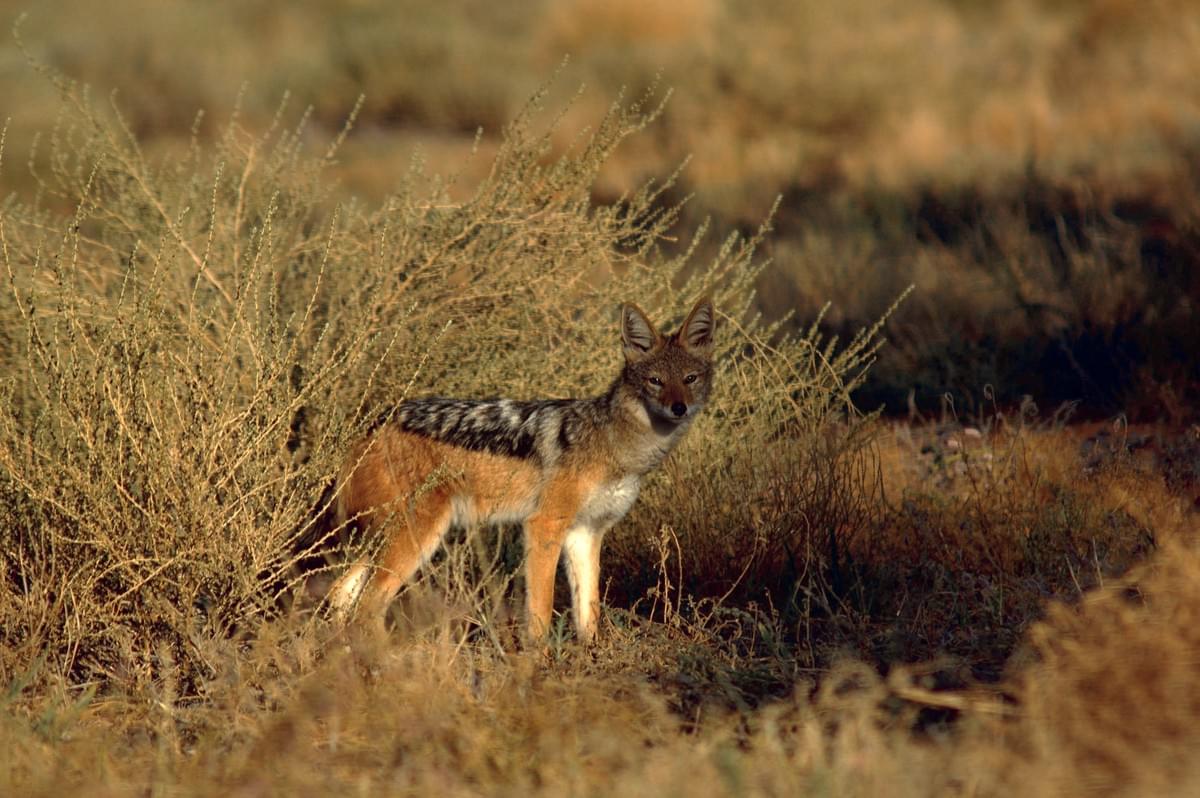
The black-backed jackal (Lupulella mesomelas) is a meso-carnivore with a varied diet that hunts its own prey (e.g., rodents, hares, and birds), readily scavenges from carcases (e.g., kills made by other predators), while also consuming fruit. Photo: W. M. Strauss)
